
This or That: Not Every Lanyard is Worth It: A Reality Check for Museum Conferences
By: Neecole A. Gregory, M.A., NEMPN Committee Member
The museum sector has a fascinating, enduring obsession with the professional conference, as most fields do. In ours, these gatherings are often presented as the ultimate career cure-all. If you are feeling hopelessly burnt out, leadership suggests you attend a conference to recharge your passion for the field. If you are desperate for a promotion, you are told to go network in a city’s convention center. If you are trying to solve systemic institutional rot or a multi-decade backlog, there is undoubtedly a panel session designed to give you all the answers you seek. Right?
The glossy brochures and call-for-proposals always promise profound enlightenment, a sense of community, and a chance to see how other institutions are surviving. But when your professional development budget is practically nonexistent, and you are already functioning as the collections manager, the education coordinator, and the marketing department all rolled into one, you must be absolutely ruthless about where you spend your time and your money. Not every lanyard is worth the price of admission, and the pressure to participate in this circuit can often feel like just another manifestation of the passion tax.
Over the years, I have attended numerous conferences at various levels and across different sectors. Having navigated this circuit from the high-altitude global summits to the pragmatic, heavily pixelated virtual rooms of state-level associations, it has become abundantly clear that not all conferences are created equal. Different tiers of the circuit serve entirely different functions, and understanding that taxonomy is the only way to avoid the crushing disappointment of returning home with a notebook full of theory and absolutely no practical solutions. To help map it out, I am going to break down the reality of the GLAM conference circuit straight from my point of view during my very first time attending each tier.
The Global Stratosphere: High Altitude, Low Oxygen
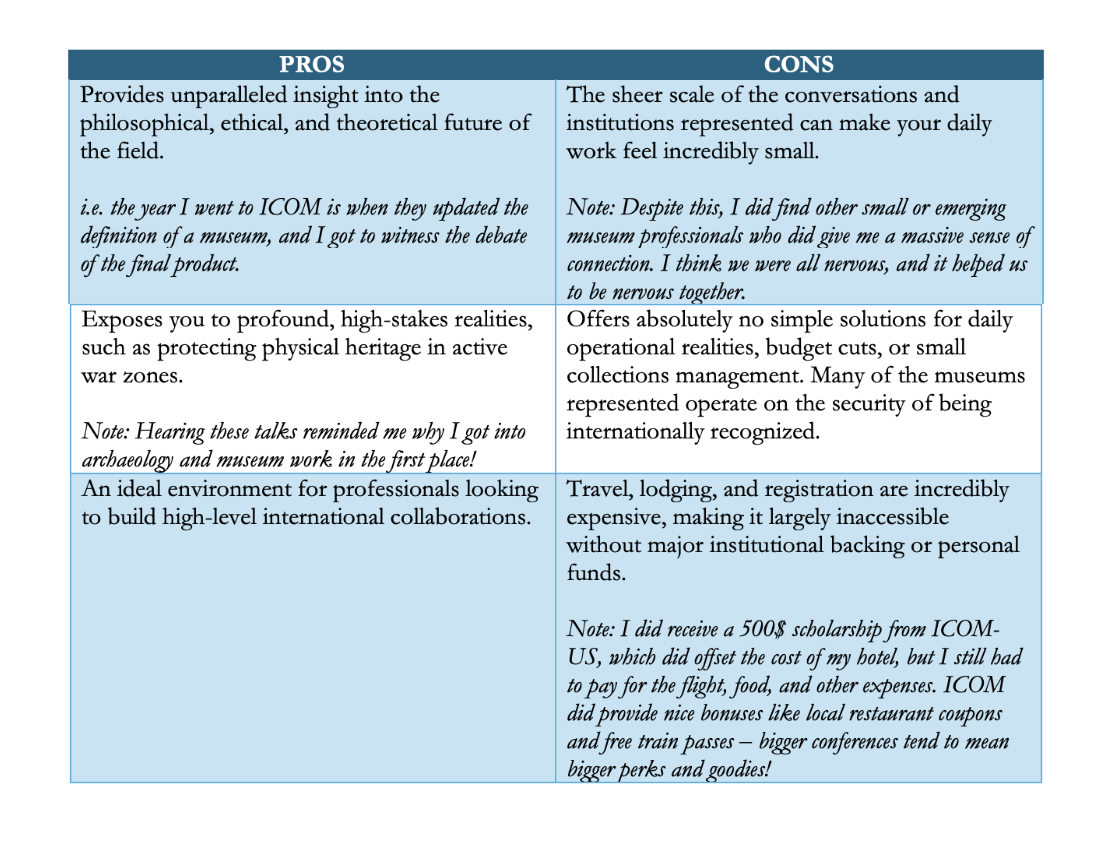
Attending an international assembly like the International Council of Museums (ICOM) conference in Prague in 2022 was a surreal, awe-inspiring, and ultimately overwhelming experience, especially with the Ukrainian-Russian War happening just a short distance away. These grand spaces operate entirely in the theoretical stratosphere. The conversations in those massive, formal halls center on international repatriation ethics, the fundamental philosophical definitions of what a museum is meant to be for the next century, and the desperate mechanics of protecting physical culture during worldwide crises.
The emotional whiplash is intense.
Seeing Ukrainian refugees gather in the historic streets outside the venue, and then sitting in a session hearing curators calmly discuss the logistics of hiding their national artifacts underground before fleeing an invasion, was simply harrowing. It reframes your entire worldview on stewardship, and for me, I felt such a profound pride in the museum field and what we were willing to do to protect culture. But it also makes the entire conference feel like an Olympic demonstration in imposter syndrome. How do you sit in a room discussing the preservation of a nation's identity under artillery fire, and then speak up about your own struggles with a municipal budget or managing community program sign-ups? You feel incredibly small, very fast.
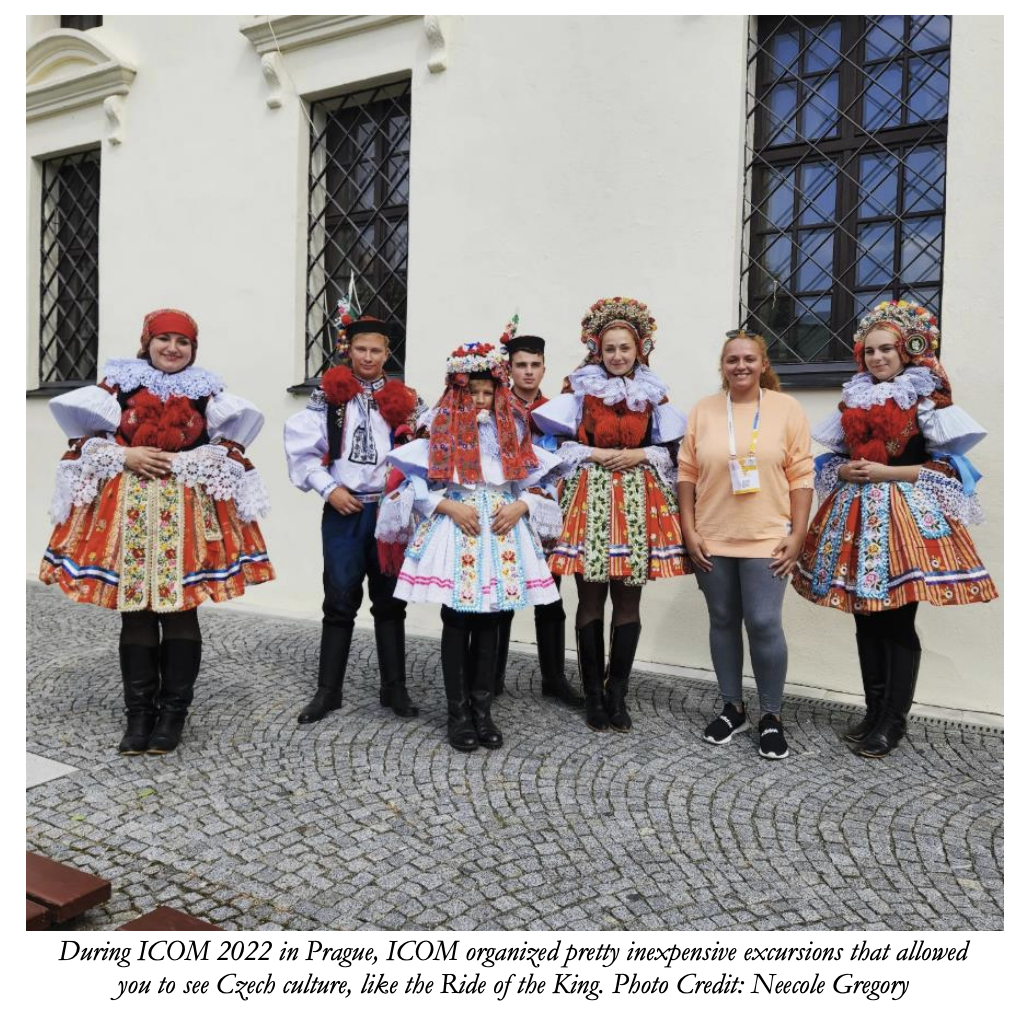
It is an undeniably incredible space for academics, senior executives, and professionals actively operating on a global scale. However, the reality for the boots-on-the-ground professional is a bit more complicated, and honestly, highly isolating. You can spend a week in Prague debating the nuanced linguistic framework of "democratized and inclusive spaces," but when you return to your local history museum, that theoretical framework does not fix a leaking roof, a fractured local board, or a nonexistent public programming budget.
The global circuit is absolutely necessary for the intellectual and ethical evolution of the field, but it is fundamentally disconnected from the daily survival mechanics of running a local or even state-level institution. It is a place where you are reminded of the profound, world-saving weight of cultural heritage, but it leaves you completely stranded when it comes to the logistics of executing it on a shoestring budget. You go to these events for macro-level inspiration, not for the duct-tape solutions.
The National Stage: Measuring the Industry (and Your Imposter Syndrome)
The massive national gatherings are where the sector goes to connect, find its bearings, and measure the shifting tides of our profession. Navigating the sprawling vendor halls at the American Alliance of Museums (AAM) in Los Angeles in 2025, walking between the specialized public history tracks at the American Association for State and Local History (AASLH) in Providence this year, or logging into the Association of Academic Museums and Galleries (AAMG) virtually in 2021 before experiencing it in person in Albuquerque in 2025 gives you an immediate, visceral sense of where the industry's focus and future are currently flowing.
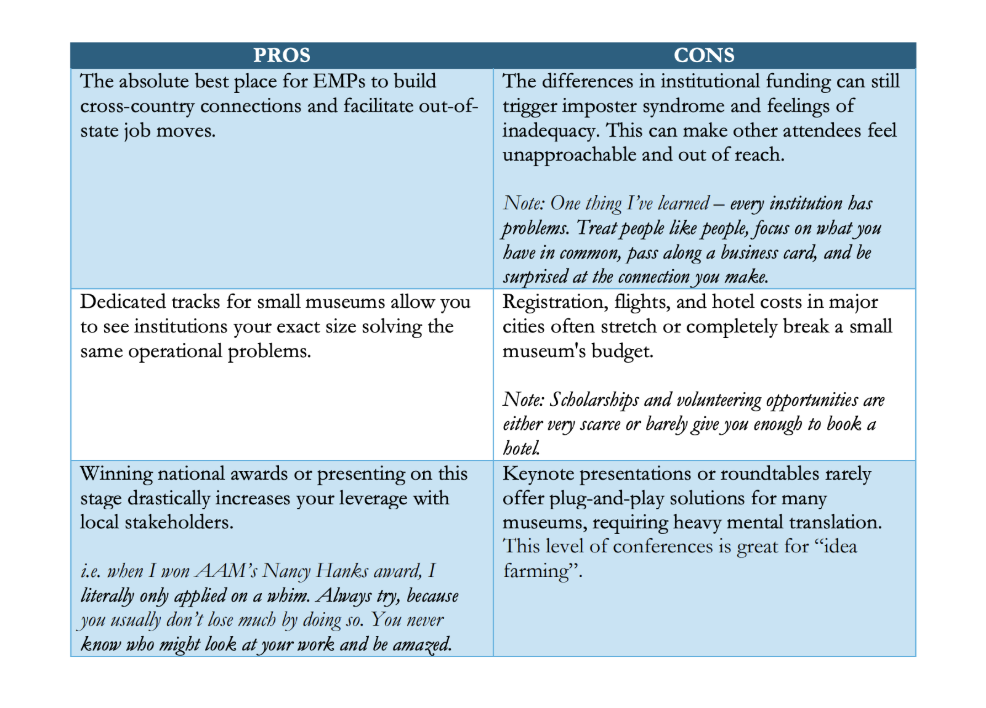
Unlike the isolating theory of global summits, the national circuit offers incredibly tangible career momentum. This is the prime environment for national networking, making it a critical tool for EMPs seeking a permanent museum home in an entirely different part of the country (i.e., as a Maryland native living in Tennessee, relocation has been my day one goal). It is also a space that actively welcomes representation of smaller institutions and the professionals who run them. Being recognized on this scale does more than validate your labor and struggles. It elevates you immediately in the eyes of your local network and proves your institutional value to your stakeholders back home.
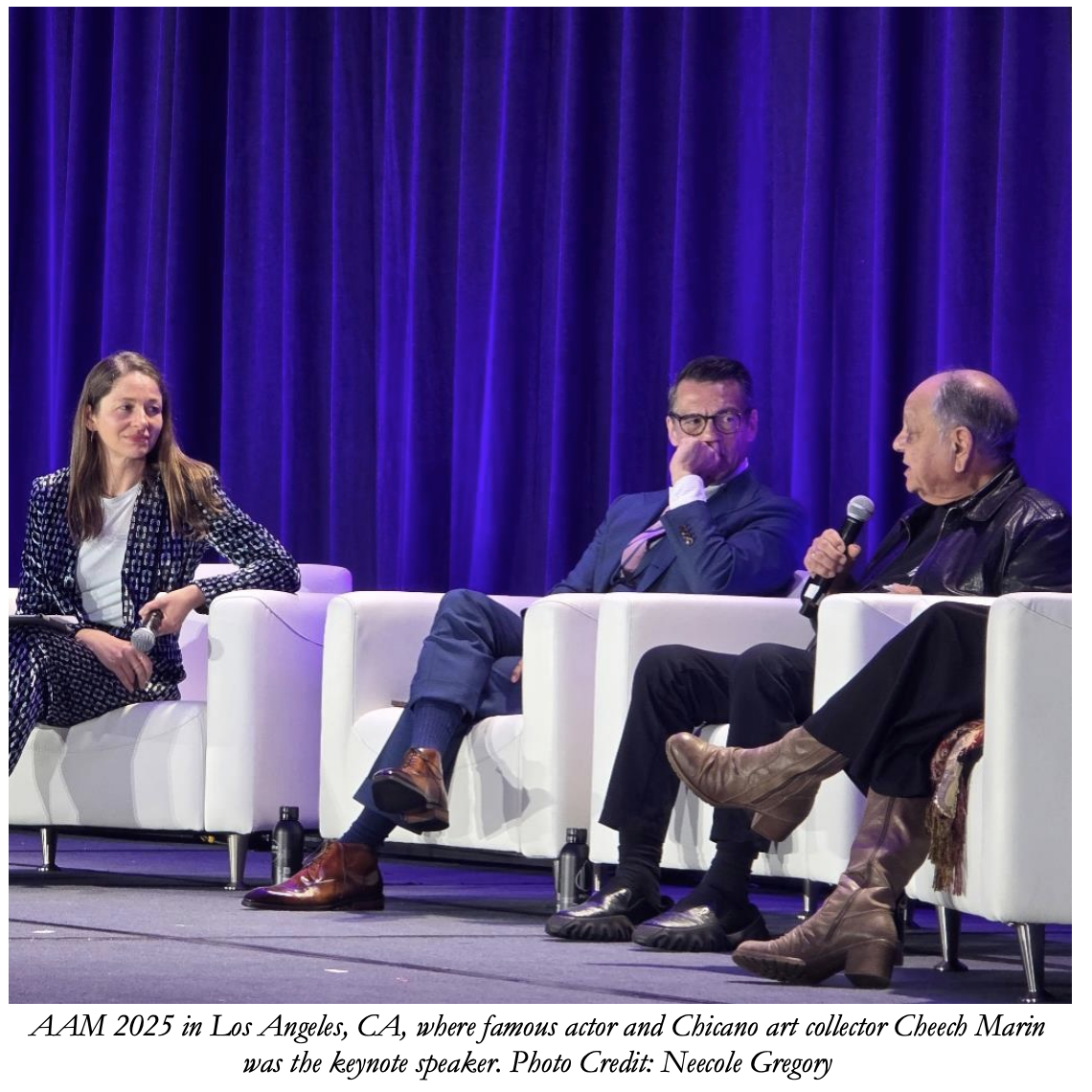
Beyond the accolades, the real currency of these events is the connections. The sheer number of out-of-state allies you can cultivate over a few days is staggering. Building a network across state lines makes job-hunting significantly easier and allows you a personal, behind-the-scenes insight into the culture and realities of other institutions before you ever send in an application. Yet, these environments remain critical barometers that require you to actively filter what is useful for your own operations. It can be a challenge to sit in a session where a massive institution casually outlines a sweeping digital initiative while you are mentally calculating the logistics of your upcoming summer youth workshops. The disconnect between a major museum's capabilities and a micro museum's daily realities becomes painfully obvious in these spaces, as they tend to do, but it’s technically your job to make the pieces fit.
The trick to surviving the national mega-events is absolute emotional detachment from the scale of other people's resources. You must extract the underlying methodology from their shiny presentations and figure out how to scale it down to your current environment. You go to these events to map the national trajectory, to build your out-of-state brain trust, and to find commiseration at the hotel bar with peers who are fighting the exact same structural battles.
The State and Regional Lifelines: Operations in the Trenches
If international conferences are philosophy and national conferences are the compass, state and regional conferences are the absolute backbone of GLAM sector survival.
Logging into a virtual Tennessee Association of Museums (TAM) session back in 2020 proved that you do not need a massive travel stipend, an international flight, or a convention center to find deep, practical solidarity. State-level associations are where the pretense drops completely. There is a specific kind of magic that happens when you gather with regional colleagues who are navigating the exact same state funding hurdles, the exact same legislative landscapes, and the exact same regional politics.
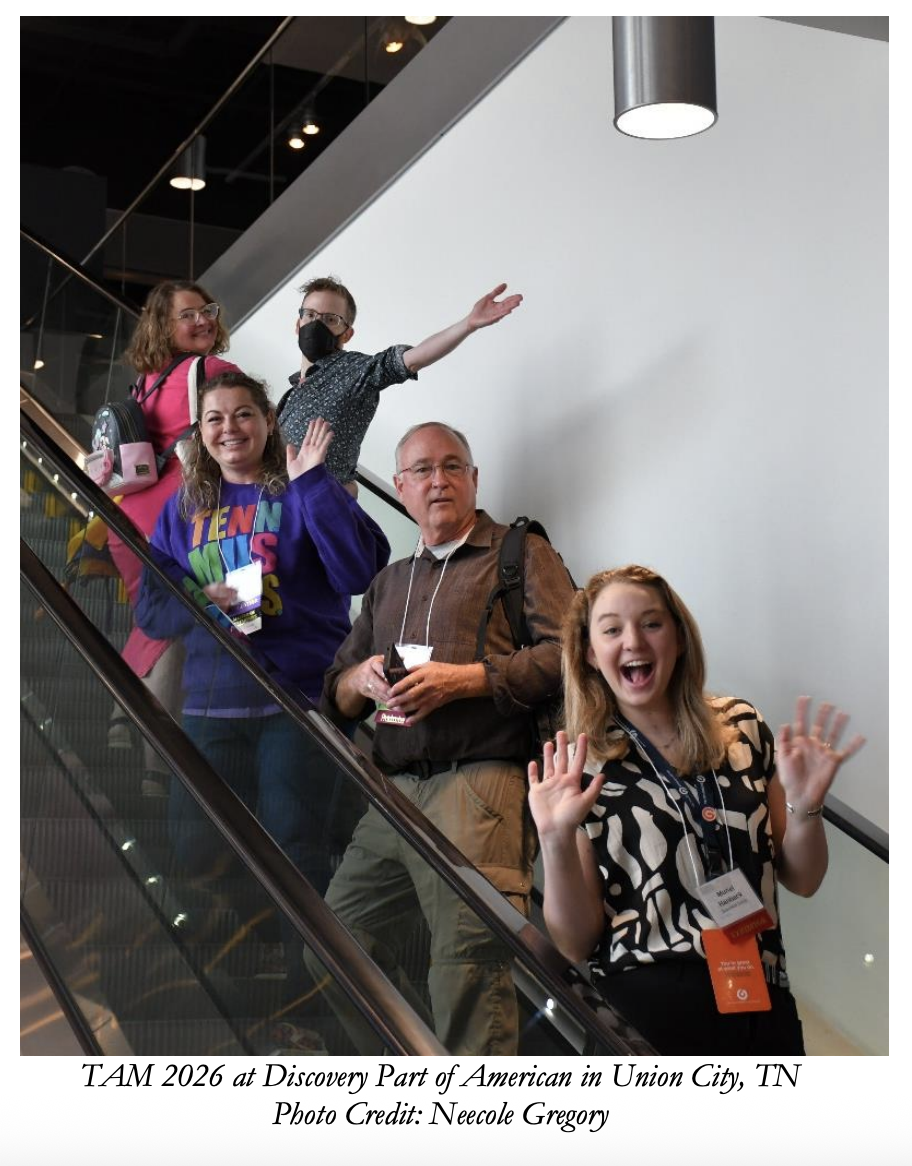
Stepping into leadership roles within these networks, such as serving as the West Tennessee Conference Chair for TAM, provides an even sharper look behind the curtain. Planning these gatherings reveals what practitioners on the ground actually need versus what national boards assume they need. The focus sharpens entirely on community survival and resource-sharing.
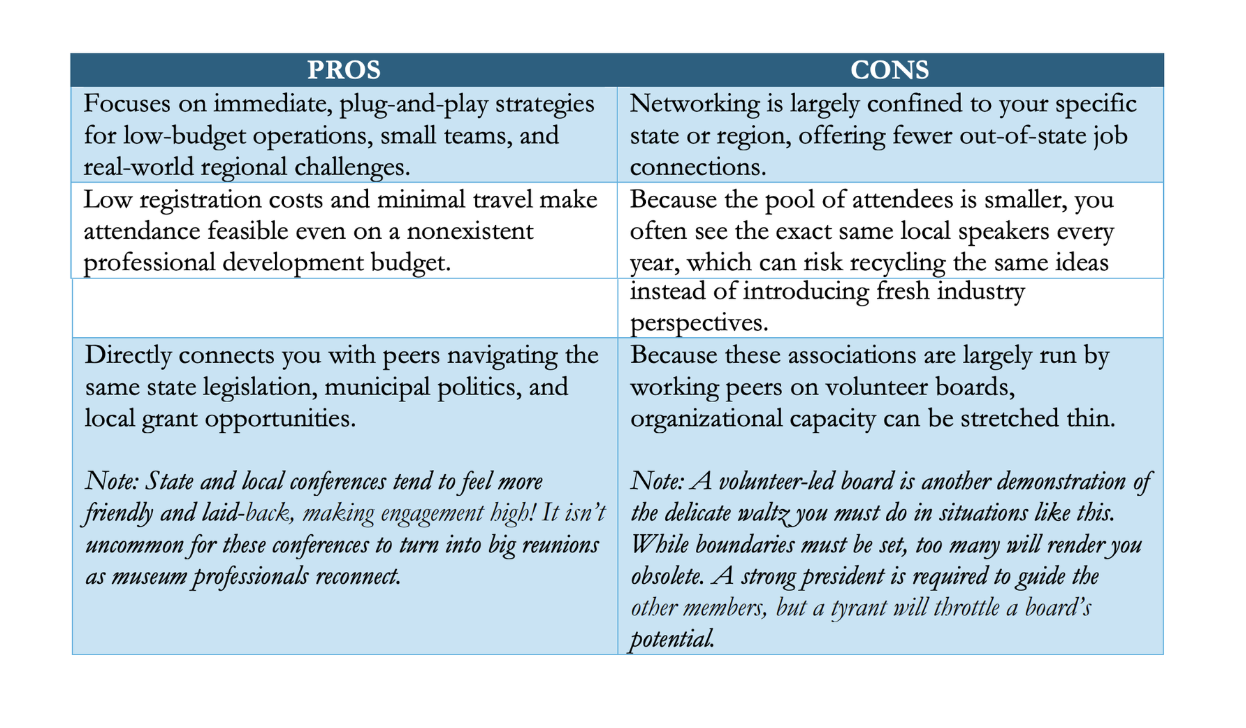
This is where the real, unglamorous work of museum stewardship is shared. The sessions are intensely practical because they must be. The conversations pivot from "what is the ideal standard?" to "how do we actually achieve this with a staff of two, a tight budget, and fifty years of uncatalogued backlog waiting in the basement?" These regional lifelines are built for the emerging professionals, the solo operators, and the micro-to-midsize institutional directors who need solutions they can actually implement on a Monday morning.
The Cost of Showing Up & Making That Cost Worth
It As inflation continues to squeeze every corner of the economy, the museum conference circuit is facing a severe financial reality check. It is not just that plane tickets, ride-shares, and hotel room blocks in host cities are reaching record highs. The underlying cost of putting on these events has exploded.
From astronomical venue lease rates and mandatory tech packages down to the eye-watering fees for renting basic folding chairs, tables, and convention hall booths, hosting an industry gathering has become a massive financial gamble for associations. Even AAM laments that ticket sales only cover about 70% of their annual conference costs, likely the largest in the country, with tickets costing at least a couple hundred dollars. Naturally, those soaring overhead costs get passed directly down to the attendees through increasingly steep registration fees. When a single registration badge costs half of a small museum’s annual professional development budget (or worse, comes out of a worker's personal pocket), the stakes couldn't be higher.
You can no longer afford to attend a conference simply out of habit or vague obligation. In this economy, every dollar spent on travel and registration must deliver a direct, measurable return on investment for your career and your sanity. To decide which conference tier is actually worth your time and money, evaluate your current career stage and immediate operational needs:
Choose International IF: You are an academic, executive, or policy specialist working on high-level global ethics, international repatriation, or macro-level cultural policy, and you have major institutional funding or grant backing to cover the trip.
Choose National IF: You are an Emerging Museum Professional seeking out-of-state job mobility, trying to elevate your institution's profile with national accolades and/or exposure, or needing to reverse-engineer high-budget engagement strategies by connecting with smallmuseum tracks across state lines.
Choose State & Regional IF: You are in the operational trenches, running on a tight budget, fighting hyper-local politics, or working as a solo operator. This is where you get the highest practical yield per dollar spent, practical solutions, and targeted local advocacy.
Regardless of which tier you choose, showing up is only half the battle! If you spend your time lingering on the periphery, hovering by the coffee table, or quietly ducking out after sessions, you are leaving the most valuable part of the experience on the table. To truly maximize your time and budget, follow these three guidelines that I’ve developed over the many conferences I’ve attended:
Ditch the Wallflower Mentality: Walking up to a circle of strangers or introducing yourself to a speaker after a panel is intimidating, but passive lingering guarantees zero return on your investment to come in the first place. Everyone in that room is paying to connect, and most people are secretly waiting for someone else to make the first move. Walk up, introduce yourself, and own your space in the room. You might find a new friend to go to the conference after-party with!
Prioritize Real Connection Over Card Collecting: This isn’t Pokémon, and you shouldn’t be trying to catch them all. Don't measure networking success by how many business cards or LinkedIn connections you gather. Focus on having three or four real, unvarnished conversations where you actually discuss the shared reality of your work, operational headaches, or mutual goals. This is what makes people remember you, whether it’s at another conference entirely or when they see your resume pass over their desk.
Follow Up While the Momentum Is Hot: The real ROI happens in the 48 hours after you get home. Send a quick, personalized note or connection request referencing something specific you discussed. A simple "Loved our chat about exhibition installation hacks over coffee!" solidifies the connection before you both get swallowed up by the shift back into your normal day-by-day and all the expense reporting this trip caused.
The Line in the Sand
Above all, remember the golden rule of boundary-setting in the cultural sector: professional development should never become a personal subsidy for your employer. If an institution expects you to represent them, stay current on best practices, and bring back actionable strategies to keep their doors open, they must fund that expectation. The normalization of museum workers paying out-of-pocket for flights, hotels, and registration fees just to stay relevant in the field is one of the most insidious manifestations of the passion tax.
We work in an industry where the vast majority of professionals already struggle to cover basic living expenses on their salaries alone. Asking those same workers to self-fund a thousand-dollar conference trip under the guise of dedication to the field is a profound structural failure. The sector conditions us to believe that if we truly cared about the collections, the community, or our own career trajectory, we would simply figure out a way to make it work. This mindset enables institutions to treat staff training as an expendable luxury rather than a fixed operational necessity, especially if owned by a non-museum entity. It’s long been time to break this cycle.
A conference badge is just a piece of plastic. It does not measure your worth, your dedication, or your skill as a cultural steward. You are not less committed to public history because you refused to max out a personal credit card for a hotel block. Be ruthless with your professional development budget. Choose the rooms that actively serve your growth, but demand that the institution pays for your presence in them. When budget season arrives, fight to have travel and registration line items permanently enshrined in your departmental funding. If the administration says there is absolutely no money for you to attend, you must practice the hardest boundary of all: you simply do not go. Even better? If you do, you do it with little to no association to your institution outside of listing it as your current host.
Never go into personal debt to prove your commitment to an industry that should be investing in you. If they won't fund your seat at the table, don't pay out of pocket to drag your own chair to it.
Download the PDF version of this article HERE.
Wanna learn more about Neecole? Read her Volunteer Spotlight in our October 2026 Newsletter.